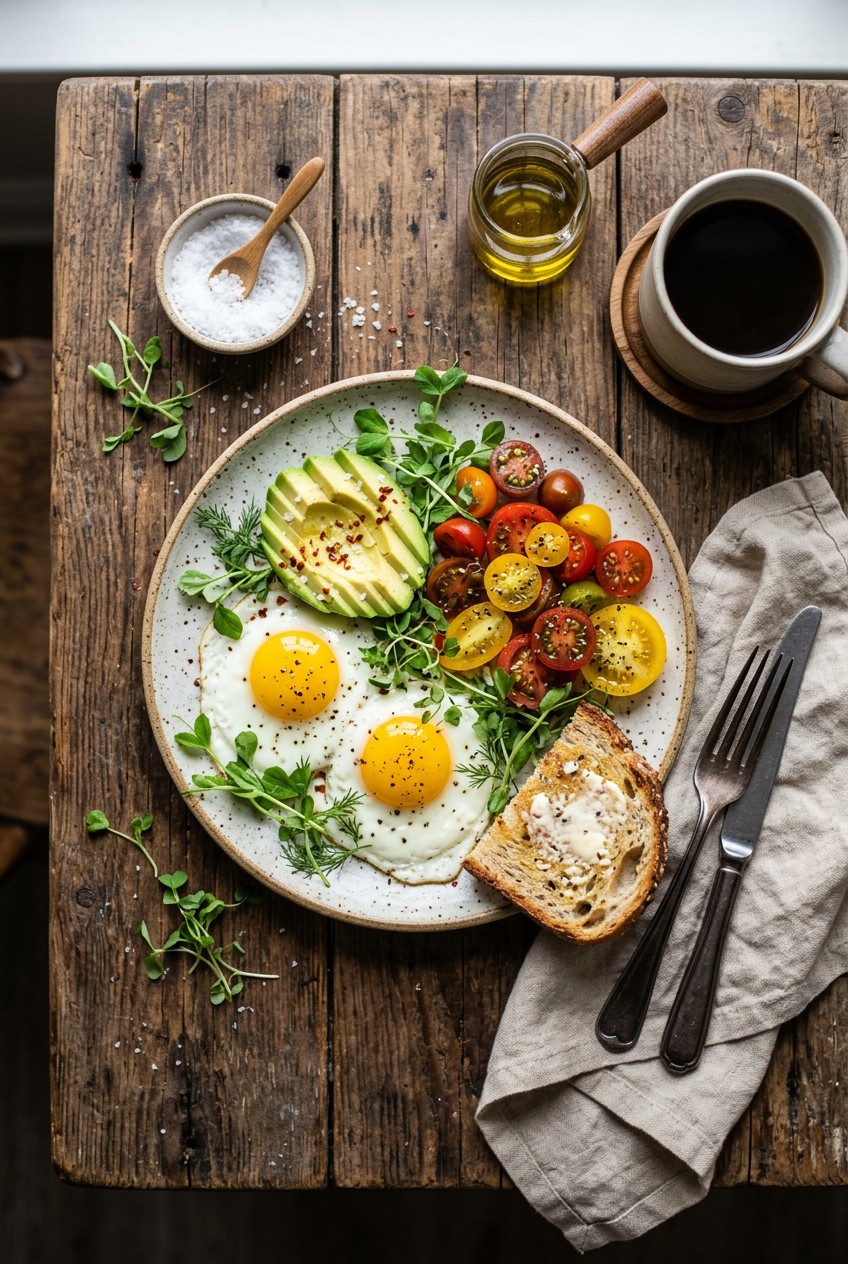
What’s Inside
- Start Your Healthy Egg Breakfast With Pasture-Raised Eggs
- Eat The Whole Egg (Yes, Even The Yolk)
- Poach Or Soft-Boil For Maximum Nutrients
- Cook On Medium-Low Heat To Avoid Rubbery Scrambles
- Preheat Your Pan With Avocado Oil
- Master The 8-Minute Hard Boil (No Green Rings)
- Top With Microgreens For A Massive Nutrient Boost
- Pair Your Healthy Egg Breakfast With Real Sourdough
- Add Fermented Hot Sauce For Gut Health
- Mix In High-Fiber Vegetables
- Build A Savory Whole Grain Bowl
Last Tuesday at Whole Foods, I stood in the egg aisle staring at forty different cartons until my head physically hurt. For years, my version of a healthy egg breakfast was microwaving pale, watery egg whites in a plastic Tupperware container before rushing to my office job. It tasted exactly like a wet dish sponge. I’m embarrassed to admit how long I forced myself to eat that rubbery mess because I thought I was being healthy. I’d sit at my desk at 9 AM, stomach growling, wondering why my diet wasn’t working. Now, I know better. Creating a breakfast that actually keeps you full until lunch isn’t about stripping away the flavor or avoiding fat. It’s about using the right ingredients, mastering the heat in your pan, and choosing smart pairings. Skip the fat-free stuff. It tastes like wet cardboard. Let’s fix your morning routine with these eleven specific methods I’ve learned through years of trial and error in my own kitchen.
1. Start Your Healthy Egg Breakfast With Pasture-Raised Eggs

I can’t stress this enough. The foundation of a truly healthy egg breakfast starts before you even turn on the stove. You need to prioritize pasture-raised eggs. Most people grab the cheapest carton of conventional eggs, but I’ve learned that you get exactly what you pay for. Trust me on this. Opt for brands like Vital Farms or Pete & Gerry’s. These brands ensure their hens have at least 108 square feet of outdoor space per bird to roam, forage, and eat bugs. The difference in quality is visually shocking. When you crack a pasture-raised egg, the yolk isn’t a sad, pale yellow. It’s a deep, vibrant, sunset orange that stands up tall in the hot cast iron pan.
These eggs contain two to three times more Omega-3 fatty acids than conventional eggs. They also pack significantly higher levels of Vitamins A, D, E, and K, plus up to eight times more Beta-carotene. I usually grab a dozen Vital Farms eggs at Sprouts, and they typically cost between $6.00 and $9.00 depending on the week. Yes, you’re paying a premium. But the enhanced nutrient profile makes them a worthwhile investment for your brain and body. I used to buy the cheap $2.00 cartons, but once I saw and tasted the difference, I promised myself I won’t ever go back. The rich flavor alone is worth the extra few dollars.
2. Eat The Whole Egg (Yes, Even The Yolk)

Please stop throwing your egg yolks down the garbage disposal. I spent most of my twenties separating egg whites because diet culture convinced me the yolks were bad for my cholesterol. That was a massive mistake. I learned that the hard way. Embrace the whole egg for its incredible choline power. One large egg provides an impressive 147 to 169 mg of choline, which is primarily concentrated right there in the golden yolk. That covers about 25 to 38 percent of the daily recommended intake for adults.
Choline is absolutely vital for brain function, memory retention, and maintaining healthy cell membranes. Eggs are literally one of the best dietary sources of this nutrient on the planet. While egg whites offer a fat-free, high-protein option, giving you about 3.6 grams of protein per white, whole eggs are nutritionally superior for most people. The yolk contains the majority of the egg’s vitamins, including D, A, E, K, and B12. It also holds healthy fats and crucial antioxidants like lutein and zeaxanthin, which protect your eye health. If you’re looking for general health and muscle maintenance, whole eggs provide a much more complete nutritional package. Don’t fear the fat. It’s exactly what keeps you full and focused all morning.
3. Poach Or Soft-Boil For Maximum Nutrients

If you want to get the absolute most out of your expensive pasture-raised eggs, you need to rethink how you cook them. According to nutrition experts, cooking eggs in water is the healthiest method available. Poaching or boiling requires zero added fats and minimizes protein denaturation. This gentler cooking process allows your body to absorb the nutrients much more efficiently. A soft-boiled egg cooked for exactly four minutes retains significantly more nutrients than a hard-boiled one simply due to the shorter exposure to heat.
I used to be terrified of poaching eggs. I’d end up with a cloudy pot of white wisps and a broken yolk. I tried the viral trick of adding vinegar and salt to the water. Here is a lesser-known poaching rule I learned the hard way. Do not put salt in the water. Salt actually causes the egg whites to break apart, making it incredibly hard to achieve a neat, cohesive poached egg. Add your salt and pepper only after the eggs are fully cooked and sitting on your plate. I finally bought a simple stainless steel slotted spoon at Target for $5.99, and it completely changed my poaching game. Just a gentle simmer, a quick swirl of the water, no salt, and four minutes of patience.

KIND Breakfast Bars, Peanut Butter, Healthy Snacks
Honestly, KIND Breakfast Bars surprised me — sturdier than it looks in the photos, and over 16 buyers gave it 4.5 stars.
4. Cook On Medium-Low Heat To Avoid Rubbery Scrambles

We need to talk about scrambled eggs. For years, I cooked my eggs on screaming high heat because I was always rushing to get out the door. The result was always a dry, rubbery sponge with crispy brown edges. A common mistake is blasting eggs with high heat. This violently overcooks the delicate proteins and physically forces the water content out of the egg, leaving a tough, unappetizing texture in your pan. Instead, you’re going to use medium to medium-low heat for all stovetop preparations. You might also like: 20 Gorgeous Healthy Lunch Ideas That Make a Real Difference
Another mistake leading to uneven texture is not whisking your eggs enough before they hit the heat. For perfectly uniform and fluffy scrambled eggs, you must whisk two to three eggs vigorously in a glass bowl. Use a fork or a metal whisk and beat them until no clear strands of egg white remain. It should be a single, uniform pale yellow liquid. When you pour them into a gently heated pan, they cook slowly and evenly. You just gently push them around with a silicone spatula. The difference in texture is shocking. They turn out soft, creamy, and tender every single time. I’ve ruined so many breakfasts by rushing the heat, but I won’t make that mistake again. You might also like: 15 Lovely High Protein Low Calorie Dinner Ideas for a Fresh New Look
5. Preheat Your Pan With Avocado Oil

Adding eggs to a cold pan is a guaranteed disaster. It leads to uneven cooking, and half your breakfast will end up cemented to the bottom of the skillet. You must always preheat your pan with a healthy fat. I personally swear by using a high-quality non-stick pan. I use the T-fal Ultimate Hard Anodized Nonstick 10-inch Fry Pan. You can usually find it for $30.00 to $50.00, and it’s worth every penny for cooking eggs. Place it on the stove over medium heat and let it warm up for a solid minute. You might also like: 15 Inspiring Aesthetic Healthy Snack Ideas to Steal Right Now
Then, add a small amount of healthy fat. I use one to two teaspoons of a high smoke point oil. My absolute favorite is Chosen Foods 100 Percent Pure Avocado Oil. I buy the 16.9 fluid ounce bottle at Costco for around $10.00 to $15.00. While you want to avoid excessive greasy fats, using a small amount of healthy fat is crucial for both flavor and nutrient absorption. The fat helps prevent sticking and actively enhances your body’s ability to absorb the fat-soluble vitamins found in the egg yolk. Let the oil heat up until it shimmers slightly, then pour in your eggs. You’ll hear a very gentle sizzle, which means your pan is perfectly ready.
6. Master The 8-Minute Hard Boil (No Green Rings)

Nothing ruins my appetite faster than biting into a hard-boiled egg and seeing an ugly, chalky green ring around the yolk. Combine that with a strong sulfur smell, and I’m instantly grossed out. I used to boil my eggs for fifteen minutes straight, thinking they needed to be fully cooked through. Over-boiling eggs causes a chemical reaction between the sulfur in the egg white and the iron in the yolk, creating that unappetizing green-gray ring.
Let’s fix this right now. For perfect hard-boiled eggs with bright, creamy yellow centers, place your eggs in a pot of cool water. Bring the water to a rolling boil over high heat. The second it boils, turn the heat down to a gentle simmer and set a timer for exactly eight minutes. Not ten, not twelve. Eight minutes. While they simmer, prepare a bowl filled with cold water and ice cubes. The moment your timer goes off, use a spoon to transfer the eggs immediately into the ice bath. This shocks the eggs, stops the cooking process instantly, and shrinks the egg slightly inside the shell. Leave them in the ice water for five minutes. They’ll peel perfectly, smell fresh, and taste incredibly creamy.
Simple Mills Almond Flour Snack Bars, Spiced Carrot Cake
A dependable everyday pick — Simple Mills Almond Flour Snack Bars pulls in 532 ratings at 4.5 stars. Not flashy, just solid.
7. Top With Microgreens For A Massive Nutrient Boost

If you want to upgrade your breakfast to the next level, you need to start using microgreens. This is a massive trend for 2026, and I’m completely obsessed with it. Microgreens are essentially the tiny seedlings of vegetables and herbs, and they are nutritional powerhouses. Research shows that varieties like broccoli or radish microgreens are up to forty times more nutrient-dense than their mature plant counterparts. They are absolutely packed with vitamins C, E, K, and beta-carotene.
I like to sprinkle a generous handful, approximately 1/4 cup, over my scrambled eggs just before eating. They add a fresh, earthy, slightly peppery crunch that perfectly cuts through the richness of the eggs. I bought a small starter growing kit from True Leaf Market for about $25.00, and growing them on my windowsill is surprisingly easy. If you aren’t into gardening, I frequently grab fresh, pre-cut packs of broccoli microgreens at Trader Joe’s for about $3.99. Honestly, this changed how I view garnishes. It’s not just pretty green decoration. It’s a functional, powerful nutritional punch that takes zero extra cooking time.
8. Pair Your Healthy Egg Breakfast With Real Sourdough

For the longest time, I completely banned bread from my house. I thought all carbs were the enemy of a healthy morning routine. I’d eat my eggs plain and find myself starving by 10 AM. Then I learned about the magic of real, fermented sourdough bread. Instead of conventional white toast that spikes your blood sugar, choose a high-quality sourdough. The traditional fermentation process used to make sourdough naturally breaks down phytic acid. Phytic acid is an antinutrient found in grains that blocks your body from absorbing minerals.
Because the fermentation breaks this down, your body can actually absorb the iron, zinc, and magnesium from the bread. It also makes the gluten much easier to digest for many people. While the high heat of the baking process kills the live probiotics, the bread still offers incredible prebiotic benefits to feed your gut bacteria, plus it has a much lower glycemic index than regular bread. I buy fresh sourdough boules from the bakery section at Kroger for about $4.99. I slice off a thick piece, toast it until the edges are deeply golden and crunchy, and serve my soft-boiled eggs right on top. The complex carbs keep my energy perfectly stable all morning.
9. Add Fermented Hot Sauce For Gut Health

If you’re anything like me, you love a good kick of spice in the morning. But instead of using sugar-laden ketchups or generic hot sauces, I’ve switched entirely to fermented hot sauces. This is a brilliant, surprising tip for improving your gut health without swallowing a giant probiotic pill. Fermented hot sauces are rich in natural probiotics. These are the beneficial bacteria that actively support a healthy gut microbiome, aid your daily digestion, and can even help boost your immune system.
I typically use Tabasco Original Red Sauce, which is naturally fermented in oak barrels for up to three years. If I want something fruitier and spicier, I reach for artisanal brands like Yellowbird Habanero Hot Sauce. You can find Yellowbird at most grocery stores now for about $5.00 to $8.00 a bottle. I just add a few dashes, maybe 1/2 to 1 teaspoon, directly over my cooked eggs. It provides a sharp, tangy vinegar sting that wakes up my palate and delivers a fantastic gut-healthy kick. Just make sure you check the label. You’re looking for sauces that list simple ingredients like peppers, vinegar, salt, and garlic, without a bunch of added preservatives or artificial gums.

Veratify Healthy Mixed Snack Box (66 Count) Snacks Gift
A dependable everyday pick — Veratify Healthy Mixed Snack Box (66 Count) Snacks Gift Basket Granola pulls in 72 ratings at 4.5 stars. Not flashy, just solid.
10. Mix In High-Fiber Vegetables

Eggs are fantastic for protein and fat, but they contain absolutely zero fiber. If you want a healthy egg breakfast that truly keeps you full, you must align with the 2026 nutrition trend of fiber-first pairings. Fiber is the secret weapon for sustained satiety. It physically stretches your stomach and slows down digestion. I used to just eat two eggs and call it a day, but I’d always crash. Now, I make sure my breakfast pan is loaded with colorful produce before the eggs even go in.
My go-to formula is a two-egg scramble packed with vegetables. I heat my pan, add a tiny bit of oil, and throw in 1/2 cup of fresh spinach and 1/4 cup of finely diced red bell peppers. I let the peppers soften and the spinach wilt down completely. Then, I pour my whisked eggs directly over the vegetables. This simple addition provides essential vitamins, vital minerals, and the crucial fiber needed to keep you full and energized for hours. I usually do a big produce run at Walmart on Sundays to stock up on huge bags of spinach for exactly this purpose. It adds incredible volume to your meal for barely any extra calories.
11. Build A Savory Whole Grain Bowl

Sometimes a plate of eggs just isn’t enough to get me through a heavy workout day. When I need serious, long-lasting fuel, I build a savory breakfast bowl. Trending heavily in 2026, savory breakfast bowls offer a perfectly balanced, complete meal that hits every single macronutrient target. You aren’t just relying on the eggs. You’re building a foundation of complex carbohydrates that release energy slowly.
I start with a base of 1/2 cup of cooked whole grains. Quinoa and farro are my absolute favorites because they have a wonderful, chewy texture and a slightly nutty flavor. I top the warm grains with two to three scrambled or poached eggs. Then, I add 1/4 of a freshly sliced avocado for extra dietary fiber and monounsaturated fats. Finally, I finish the bowl with a light drizzle of high-quality extra virgin olive oil. I highly recommend California Olive Ranch Extra Virgin Olive Oil. You can find the 25.3 fluid ounce bottle for around $10.00 to $18.00 at almost any grocery store. The richness of the oil, the creaminess of the avocado, and the hearty grains create a protein, healthy fat, and complex carbohydrate-rich start to your day. No exaggeration, you won’t even think about snacking until lunchtime.
I hope these detailed tips completely change how you view your morning routine. You don’t have to suffer through bland, rubbery egg whites ever again. By choosing quality ingredients, treating them gently in the pan, and pairing them with fiber and complex carbs, you’ll feel energized all day long. I highly recommend saving or pinning this guide so you can reference these specific cooking times and brand recommendations the next time you’re standing confused in the grocery store aisle!
Frequently Asked Questions
Are whole eggs better than egg whites for a healthy breakfast?
Yes. While egg whites are high in protein, the yolk contains essential vitamins, healthy fats, and choline. Eating the whole egg provides a more complete nutritional profile that keeps you full and energized much longer.
How long should I boil an egg so it doesn’t get a green ring?
To avoid the unappetizing green sulfur ring, bring your water to a boil, reduce to a simmer, and cook the eggs for exactly 8 minutes. Immediately transfer them to an ice water bath for 5 minutes to stop the cooking process.
What is the best oil to use when cooking eggs?
I highly recommend using 1 to 2 teaspoons of a high smoke point oil like 100% pure avocado oil or a high-quality extra virgin olive oil. This prevents sticking and helps your body absorb the fat-soluble vitamins in the egg yolk.
How can I make my egg breakfast more filling?
Pair your eggs with high-fiber ingredients. Try adding 1/2 cup of sautéed spinach and bell peppers, serving them over a half cup of cooked quinoa, or eating them with a slice of real fermented sourdough bread.
