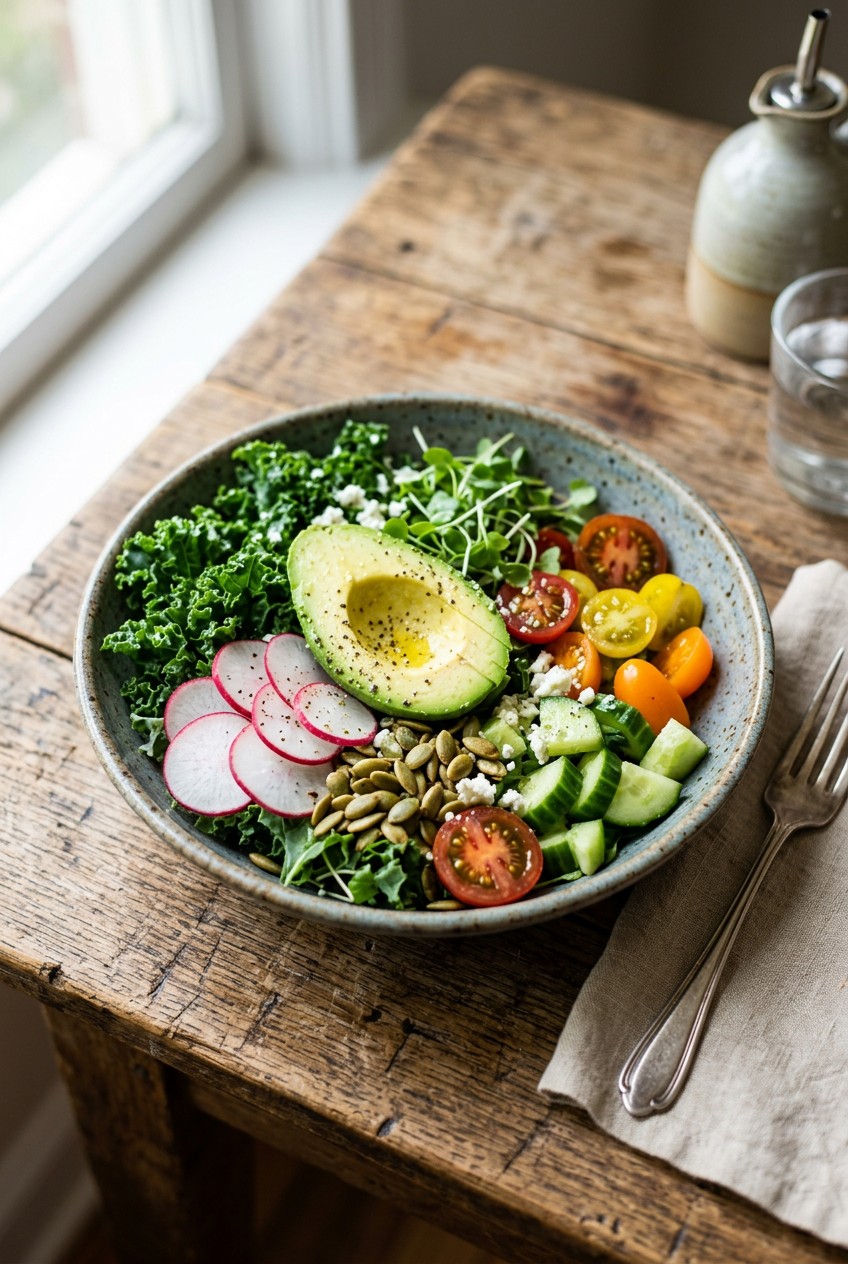
What’s Inside
- Prioritize Nutrient-Dense Greens Over Iceberg
- Balance Protein for Sustained Satiety
- The Dressing Dilemma in Green Salad Recipes
- Incorporate Complex Carbohydrates for Energy
- Create a Rainbow with Non-Starchy Vegetables
- Prevent Soggy Salads with the Jar Method
- Explore Fermented Ingredients and Fresh Herbs
- Sweet Additions to Your Green Salad Recipes
Last Tuesday at Whole Foods, I stared down a $14 pre-packaged wilted spinach bowl and realized I’d hit rock bottom. I was desperately trying to find reliable green salad recipes that didn’t taste like wet lawn clippings.
I used to buy those massive plastic clamshells of iceberg lettuce, dump a quarter cup of neon orange French dressing on top, and call it health. It was awful. The lettuce was always slimy by Wednesday. The dressing tasted like pure corn syrup. I’d eat it at my desk, feeling miserable and hungry an hour later. Let’s fix this. I’ve spent the last four years figuring out exactly how to build a bowl of greens that actually fills you up. No more sad desk lunches. No more tossing out rotten vegetables. I’m sharing the exact formulas I use in my own kitchen every single week. You don’t need to be a professional chef to make these work. You just need a few basic techniques and the right ingredients. I’ll walk you through everything from massaging tough leaves to roasting the perfect crunchy toppings. Grab your cutting board, and let’s get into the details.
1. Prioritize Nutrient-Dense Greens Over Iceberg

Iceberg lettuce? It’s basically crunchy water. Skip the fat-free stuff and the water-logged iceberg immediately. It tastes exactly like wet cardboard. Instead, I’m completely obsessed with dark, leafy greens. Romaine, kale, spinach, or peppery arugula are your best friends here. You need exactly 2 to 2.5 ounces of mixed greens per person for a proper main course. I tried this wrong for months before figuring it out. I’d buy the absolute cheapest head of iceberg at Walmart for $1.48, chop it up, and wonder why my lunches were so intensely boring. Now, I grab the 5 oz plastic tub of Organic Baby Spinach from Target (Good & Gather brand, usually $3.29). It has a slightly earthy smell and a soft, tender texture that holds onto vinaigrette perfectly. You can’t just throw wet leaves in a bowl and expect magic.
If you’re using kale, you absolutely must massage it. I know it sounds ridiculous to give your vegetables a spa treatment. But rubbing a teaspoon of olive oil into 2 cups of chopped raw kale physically breaks down the tough cellulose fibers. It turns bright, vibrant green, gets incredibly soft, and loses that harsh bitter edge. Don’t skip this step. I ruined a dinner party in 2021 by serving raw, un-massaged curly kale. My guests were chewing for ten minutes straight per bite. It was mortifying. The sound of everyone loudly crunching on dry leaves echoes in my nightmares. You also need to wash and dry your greens properly. I use the OXO Good Grips Salad Spinner ($29.99 at Target). If your leaves are wet, the dressing will just slide right off and pool at the bottom of your bowl. Take the extra two minutes to spin them completely dry. Your taste buds will thank you.
2. Balance Protein for Sustained Satiety

If you don’t add protein, you’re going to be starving by 3 PM. I guarantee it. A massive pile of leaves won’t keep you full. You need a solid, dense protein source to anchor the meal. For plant-based bowls, I measure out exactly 1/2 cup of cooked lentils or canned black beans. I highly prefer Bush’s Organic Black Beans (15 oz can, $1.69 at Kroger). They have a creamy, dense texture that makes the whole dish feel substantial and heavy in a good way. If I’m eating meat, I aim for exactly 3 ounces. That’s roughly the size of a smartphone or a standard deck of playing cards.
I buy the 3-pound bag of Kirkland Signature Frozen Chicken Breasts from Costco for $14.99. I thaw one breast, grill it with some coarse sea salt and cracked black pepper, and slice it incredibly thin. The charred, crispy edges of the chicken add this incredible smoky flavor to the bowl. Canned tuna is another cheap, incredibly fast option. I strictly buy the Wild Planet Wild Albacore Tuna (5 oz can, around $4.50 at Sprouts). The texture is firm and meaty, not mushy and water-logged like the cheap stuff sitting on the bottom grocery shelf. I used to just sprinkle a measly tablespoon of sliced almonds on my greens and assume that was enough protein for the afternoon. It wasn’t. I’d end up binge-eating salty crackers an hour later because my blood sugar crashed so hard my hands shook. Add real, measurable protein. It changes everything about how your body processes the meal. You might also like: 20 Lovely Healthy High Protein Low Calorie Dinner Ideas Worth Trying This Year
3. The Dressing Dilemma in Green Salad Recipes

Dressing can ruin a healthy meal faster than anything else in your kitchen. Free-pouring dressing straight from the bottle is a massive mistake. Always measure it. You need approximately 2 tablespoons per serving, no more. Healthy fats actually help your body absorb fat-soluble vitamins like A, D, E, and K from the vegetables. I strictly use extra virgin olive oil or avocado oil. If I’m buying store-bought, I scrutinize the nutrition label under a microscope. You want low sodium (ideally 5% or less of daily value) and absolutely zero added sugar. Dietitians always recommend Bragg Organic Ginger & Sesame Dressing (12 oz bottle, $5.99 at Kroger). It has a sharp, tangy bite that cuts right through heavy greens. You might also like: 15 Clever Quick Healthy Breakfast Ideas Worth Trying This Year
Marie’s Creamy Ranch is surprisingly excellent too, with no added sugar and a rich, thick texture that feels indulgent. Bolthouse Farms Italian Vinaigrette is another winner. It’s only 25 calories per 2 tablespoons. But honestly, I prefer making my own vinaigrette for my green salad recipes. It’s significantly cheaper and tastes so much fresher. The golden ratio is 3 parts oil to 1 part vinegar. I mix 3 tablespoons of California Olive Ranch Extra Virgin Olive Oil ($11.99 for a 16.9 oz bottle) with 1 tablespoon of Bragg Apple Cider Vinegar. I add a fat pinch of Maldon flaky sea salt and freshly ground black pepper. I shake it violently in a tiny glass mason jar until it completely emulsifies. It’s sharp, salty, and coats the leaves beautifully. I once ruined a batch by adding a whole tablespoon of Dijon mustard instead of a teaspoon. It burned my sinuses so badly I tossed the whole jar. Measure your ingredients carefully. You might also like: 20 Beautiful Low Calorie Dinner Ideas to Transform Your Space

Cathy Yoder’s Air Fryer Cookbook for Two (2026): Easy
Cathy Yoder’s Air Fryer Cookbook for Two (2026): Easy punches above its price. I would buy it again.
4. Incorporate Complex Carbohydrates for Energy

Carbs aren’t the enemy. Please don’t skip them. A small portion of nutrient-rich, complex carbohydrates gives you sustained energy and prevents that dreaded afternoon slump. I add 1/3 to 1/2 cup of cooked, chilled quinoa to my bowl. It adds a wonderful nutty flavor and a slight chewiness that breaks up the crunch of the vegetables. You have to rinse your quinoa first, though. I buy Bob’s Red Mill Organic Quinoa (24 oz bag, $8.99 at Whole Foods). If you don’t rinse it in a fine mesh sieve under cold water, it retains a bitter, soapy coating called saponin that ruins the whole flavor profile.
Roasted organic corn or cubed roasted red potatoes are amazing additions too. I keep a 16 oz bag of Trader Joe’s Organic Roasted Corn ($3.49) in my freezer at all times. I just thaw 1/2 cup under warm water and toss it right in. Sweet potatoes are my absolute favorite, though. I chop a medium sweet potato into half-inch cubes, toss them with 1 tablespoon of avocado oil, and roast at 400 degrees for 25 minutes. The natural sugars bubble and caramelize right on the baking sheet. They get sticky on the outside and incredibly soft on the inside. I used to be terrified of adding carbs to my lunches. I thought it defeated the purpose of eating clean. I’d eat a huge bowl of raw spinach and dry chicken, and then feel completely exhausted an hour later. I’d literally fall asleep at my desk around 2 PM. Adding just 1/2 cup of roasted sweet potatoes fixed everything. The contrast of the warm, sweet potato against the cold, crisp greens is purely fantastic.
5. Create a Rainbow with Non-Starchy Vegetables

You need at least 1 cup of mixed non-starchy vegetables per salad. This creates a literal rainbow of nutrients on your plate. Carrots bring beta-carotene. Tomatoes offer lycopene. Yellow and red bell peppers are packed with Vitamin C. I also throw in raw broccoli florets, sliced English cucumbers, and earthy cremini mushrooms. The texture variation is crucial here. You want the watery, refreshing crunch of a cucumber mixed with the dense, loud snap of a raw carrot. But let’s talk about the most important texture: the crunch factor. Store-bought croutons are usually just stale bread fried in cheap, inflammatory oils. They taste like salty, artificial rocks.
Instead, I roast chickpeas. I drain and rinse a 15 oz can of Goya Garbanzo Beans ($1.29 at Walmart). I dry them completely with a paper towel. This is incredibly important. If they’re even slightly wet, they won’t crisp up at all. They’ll just steam in the oven and get mushy. I toss them with 1 tablespoon of olive oil, 1 teaspoon of smoked paprika, and 1/2 teaspoon of garlic powder. I air fry them at 390 degrees for exactly 12 minutes. They come out audibly crunchy, spicy, and perfectly salty. They’re the ultimate healthy alternative to croutons. I once burned a batch in the oven because I walked away to answer a text message. The smell of scorched paprika and burnt beans lingered in my tiny apartment kitchen for three solid days. Watch them closely while they cook.
6. Prevent Soggy Salads with the Jar Method

Soggy salads are completely disgusting. There’s nothing worse than opening your lunch container at noon and finding a slimy, brown mess of wilted leaves sitting in a pool of separated oil and vinegar. I’ve thrown away so many expensive lunches because of this exact problem. Now, I strictly use the jar salad method. It’s a massive meal prep trend for 2026, and it actually works perfectly. You need a 32 oz wide-mouth Ball mason jar ($12.99 for a 12-pack at Target). The layering strategy is everything. Pour your 2 tablespoons of dressing at the very bottom of the glass.
Next, add your hearty, non-starchy vegetables. Things like cherry tomatoes, thick cucumber slices, or chopped carrots. They can sit in the acidic dressing for days without getting gross. In fact, they quickly pickle and taste even better. Then, add your 1/2 cup of beans or grains. Next comes your 3 ounces of cooked protein. After that, add your nuts, seeds, or roasted chickpeas. Finally, stuff the entire top half of the jar with your 2 ounces of tender greens. The greens stay completely dry at the top, miles away from the liquid. When you’re ready to eat, you just unscrew the lid and dump the whole jar into a large bowl. The dressing falls over everything perfectly, coating the leaves last. It’s brilliant. I used to just mix everything in a cheap plastic Tupperware container on Sunday night. By Tuesday morning, it was an inedible, foul-smelling soup. Don’t do that. At all.

Ruibo Baggy Rack Holder For Food Prep/Ziplock Bag
Honestly, Ruibo Baggy Rack Holder For Food Prep/Ziplock Bag surprised me — sturdier than it looks in the photos, and over 211 buyers gave it 4.5 stars.
7. Explore Fermented Ingredients and Fresh Herbs

Gut health is a massive focus for 2026, and your lunch is the perfect place to address it. Adding fermented ingredients to your bowl is the easiest, cheapest way to get natural probiotics. I add exactly 1 tablespoon of Cleveland Kitchen Classic Kimchi (16 oz pouch, $5.99 at Whole Foods) to my greens. It adds a spicy, sour, funky kick that completely wakes up the whole dish. The crunch of the fermented cabbage is so satisfying. Raw sauerkraut is great too, especially paired with grilled pork or chicken. Beyond fermentation, if you aren’t using fresh herbs, you’re missing out on a massive flavor upgrade.
Fresh parsley, basil, dill, chives, and mint change the entire flavor profile of a basic bowl. A general rule is to use 1 tablespoon of fresh snipped herbs for every 1 teaspoon of dried herbs. I buy the small 0.5 oz plastic clamshells of fresh organic dill from Kroger for $1.99. I chop up 2 tablespoons and mix it directly into the leaves. The smell of fresh dill cutting through a rich olive oil dressing is intoxicating. You can also use edible flowers for a visual pop. Marigolds or nasturtiums look beautiful and add a surprising peppery bite. Just make absolutely sure they’re specifically labeled as edible and pesticide-free. I once picked a random, pretty orange flower from my neighbor’s yard and put it on a plate to look fancy for a photo. My tongue went completely numb for an hour after I took a bite. Stick to the grocery store herbs.
8. Sweet Additions to Your Green Salad Recipes

A little bit of natural sweetness balances out the bitter, earthy greens and the sharp, acidic vinaigrette perfectly. Fresh fruit is the absolute best answer. I love adding 1/4 cup of fresh pomegranate arils to my green salad recipes. They look like little glowing rubies and burst with bright, tart juice when you bite into them. I buy the 8 oz cup of POM Wonderful Pomegranate Fresh Arils from Sprouts for $4.99. It saves me the massive hassle of hacking open a whole pomegranate, getting sticky juice all over my white kitchen counters, and staining my fingers purple for two days. Learned that the hard way.
Fresh blueberries and thinly sliced strawberries are also incredible additions. I slice up three large strawberries and fan them out over the top of the bowl. The sweet, floral scent of the strawberries mixes with the sharp vinegar dressing in the best way possible. Crisp apples work beautifully too. I grab a Honeycrisp apple ($2.99/lb at Trader Joe’s), slice it paper-thin, and toss it with the greens. The loud crunch is deeply satisfying. I used to buy those giant bags of dried cranberries that are heavily coated in refined cane sugar. I’d mindlessly dump a whole handful onto my spinach. It was basically eating candy for lunch. I realized I was adding 20 grams of processed sugar to my meal without even thinking about it. Switching to fresh, whole fruit gives you that same wonderful sweetness but with way more water volume, fiber, and powerful antioxidants. It’s a much smarter choice.
I honestly eat some variation of these bowls every single day. Once you get the formula down, it’s completely effortless. You just need the right dark greens, a solid measured protein, complex carbs to keep you awake, and a dressing that doesn’t taste like synthetic chemicals. Skip the expensive drive-thru lines and start building your own jars at home. I’d love to see what wild flavor combinations you come up with using these techniques. Save this post, pin it to your weekly meal prep board, and let’s make lunch actually taste good again. You won’t regret taking the extra ten minutes to prep these properly. Trust me on this.
Frequently Asked Questions
How much dressing should I use on my green salad recipes?
You should measure out exactly 2 tablespoons of dressing per serving. Free-pouring straight from the bottle usually leads to drowning your greens and consuming excess calories. I highly recommend using a measuring spoon every single time to keep it balanced.
How do I keep my green salad recipes from getting soggy?
The absolute best way to prevent soggy leaves is using the mason jar method. Put your dressing at the very bottom, layer hearty vegetables and proteins next, and keep your delicate greens at the very top so they stay completely dry until lunch.
What is the best protein to add to green salad recipes?
For sustained energy, add 3 ounces of lean meat like grilled chicken or wild-caught tuna. If you’re eating plant-based, exactly 1/2 cup of cooked lentils or black beans works perfectly. This ensures you won’t be hungry an hour later.
Why do my green salad recipes taste so bitter?
You might be using tough, un-massaged greens. If you’re using raw kale, you must rub a teaspoon of olive oil into the leaves with your hands for a few minutes. This breaks down the tough fibers and completely removes that harsh, bitter edge.
