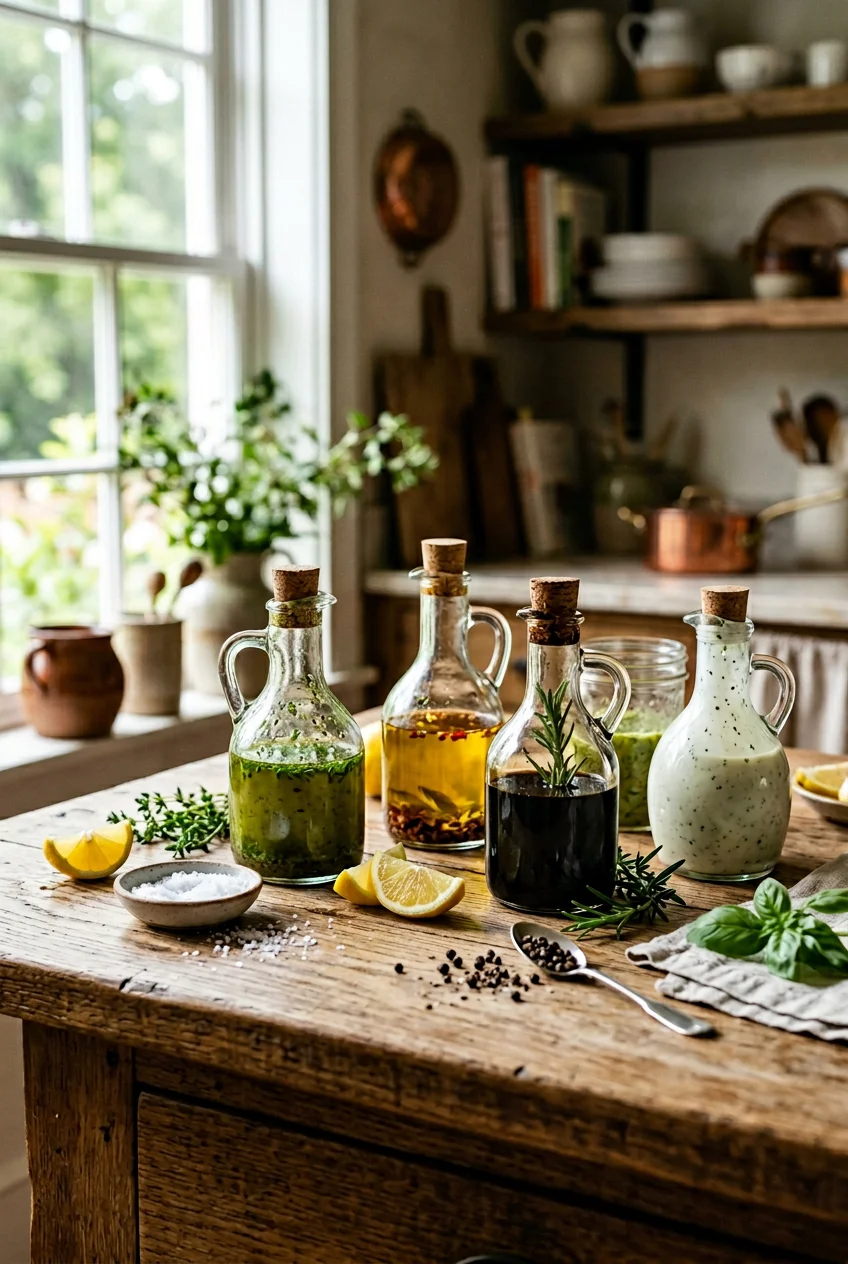
What’s Inside
- Prioritize High-Quality Extra Virgin Olive Oil
- Embrace Avocado Oil for Neutrality and Health
- Master the 3:1 Oil-to-Acid Ratio
- Harness the Power of Dijon Mustard for Emulsification
- Swap in Greek Yogurt for Creaminess
- Explore Tahini for Plant-Based Richness
- Infuse Umami with Miso Paste
- Sweeten Naturally and Sparingly
- Use Your Blender for Silky Smoothness
- Boost Flavor with Fresh Herbs and Aromatics
- Incorporate Nutritional Yeast for Cheesy Notes
- Extend Shelf Life with Smart Storage
Last Tuesday at Whole Foods, I stood in aisle four staring at a $9.99 bottle of organic green goddess dressing. I flipped it over to read the label. The second ingredient was canola oil, followed by three different gums I couldn’t pronounce. I put it back on the shelf. Finding genuinely healthy salad dressing recipes shouldn’t require a degree in food science. I spent years buying store-bought bottles that tasted like plastic and separated into weird, gelatinous layers in my fridge. Making your own takes exactly three minutes. You control the sodium. You control the fat quality. Here is how to build these at home without the unnecessary fillers and industrial seed oils.
1. Prioritize High-Quality Extra Virgin Olive Oil

The foundation of most healthy salad dressing recipes starts with your oil. I tried using cheap, generic store-brand oils for a long time. The result was always a flat, greasy vinaigrette that left a strange film on the roof of my mouth. I switched to California Olive Ranch Everyday Extra Virgin Olive Oil. You can usually find it for $10.49 for a 16.9 oz bottle at Target. It has a distinct peppery bite at the back of your throat, which means the antioxidants are actually intact. Skip the bottles labeled “light” olive oil. I bought a bottle of light olive oil at Walmart last year thinking it meant fewer calories. It doesn’t. It just means the oil is highly refined, stripped of its color, and completely devoid of the heart-healthy monounsaturated fats and beneficial compounds you actually want. You’re paying the same price for a nutritionally empty liquid. When you use a high-quality EVOO, the dressing coats the greens evenly instead of pooling at the bottom of the bowl. Pour 3 tablespoons into a glass jar. Notice the deep green-gold color. That’s what you want your base to look like. Trust me on this.
2. Embrace Avocado Oil for Neutrality and Health

Sometimes olive oil is simply too aggressive. If I’m making a delicate butter lettuce salad with strawberries, a pungent EVOO ruins the flavor. I learned this the hard way when I ruined a summer salad for a backyard barbecue by using a heavy, bitter olive oil. Now, I keep Chosen Foods 100% Pure Avocado Oil in my pantry for these specific situations. I buy the 16.9 oz bottle at Costco for $14.99. Avocado oil is incredibly neutral. It has a mild, slightly buttery texture that doesn’t fight with the other ingredients in your bowl. It’s also packed with monounsaturated fats and antioxidants that help reduce inflammation. I use it exclusively when I’m building Asian-inspired dressings with sesame and ginger, or when I want a bright citrus dressing where the lemon needs to be the dominant note. A common mistake is using highly processed vegetable oils when they want a neutral flavor. Those oils oxidize easily and promote inflammation. Avocado oil gives you that blank canvas without the negative health drawbacks. Pour 1/4 cup of avocado oil into a bowl, add 2 tablespoons of rice vinegar, and you’ve got a perfectly clean, neutral base.
3. Master the 3:1 Oil-to-Acid Ratio

The quickest way to ruin a salad is an unbalanced dressing. For months, I just eyeballed my ingredients. I usually ended up with a highly acidic, astringent puddle that made my jaw clench. The fundamental rule of a classic vinaigrette is the 3:1 ratio. That means 3 tablespoons of oil to 1 tablespoon of acid. The acid can be fresh lemon juice, apple cider vinegar, or white wine vinegar. I picked up a bottle of cheap white vinegar at Trader Joe’s once and tried to use it in a dressing. It tasted like household cleaner. Always use a proper culinary vinegar. Once you understand the 3:1 baseline, you can adjust it methodically. If I’m using a very fatty add-in like avocado chunks or feta cheese in the salad, I’d adjust the dressing to a 2:1 ratio for a sharper, tangier bite to cut through the fat. If I’m serving bitter greens like radicchio or arugula, I might stretch it to 4:1 to mellow the overall plate. Measure it out exactly the first few times. Use actual measuring spoons. 3 tablespoons of oil. 1 tablespoon of acid. Shake it in a jar. Taste it on a single leaf of lettuce before you dump it over the whole bowl. You might also like: 9 High Protein Crockpot Meals for Every Budget

Downshiftology Healthy Meal Prep: 100+ Make-Ahead Recipes
If you want something that just works, Downshiftology Healthy Meal Prep: 100+ Make-Ahead Recipes and Quick-As is a safe bet.
4. Harness the Power of Dijon Mustard for Emulsification

Oil and water inherently repel each other. If you just shake oil and vinegar together, they separate within sixty seconds. I hosted a dinner party in 2022 and served a simple green salad. By the time I brought the bowl to the table, the dressing had broken. The greens were coated in a slick layer of oil while a puddle of sharp vinegar sat at the bottom. It was deeply unappetizing. You need an emulsifier to bind them. Dijon mustard is the most reliable tool for this. I use Maille Dijon Originale Mustard. It usually runs $4.79 for a 7.5 oz jar at Kroger. You only need 1 teaspoon per 1/2 cup of dressing. The mucilage in the mustard seed physically holds the oil and water molecules together. It creates a creamy, opaque suspension that clings to your greens instead of sliding off. Don’t use standard yellow hot dog mustard. The flavor profile is entirely wrong and the vinegar content is too high. Spoon 1 teaspoon of Maille Dijon into your jar before you add the oil and vinegar. Shake it vigorously for fifteen seconds. You’ll see the liquid transform from separated layers into a unified, silky dressing. You might also like: 15 Lovely High Protein Low Calorie Dinner Ideas for a Fresh New Look
5. Swap in Greek Yogurt for Creaminess

I grew up eating heavy, mayonnaise-based ranch dressing. When I started cleaning up my diet, I tried the fat-free, yogurt-based dressings from the grocery store. Skip the fat-free stuff. It tastes like wet cardboard and usually contains added sugar to compensate for the missing fat. You need a little bit of fat for mouthfeel and satiety. I now use plain Greek yogurt as the base for all my creamy healthy salad dressing recipes. Specifically, I use Fage Total 5% Milkfat Plain Greek Yogurt. I grab the 17.6 oz tub for $5.49 at Sprouts. The 5% fat content is crucial. It provides a rich, satisfying texture with significantly less tang than the 0% versions. To make a clean ranch substitute, I whisk 1/4 cup of the Fage yogurt with 1 tablespoon of water to thin it out. Then I add 1/2 teaspoon of garlic powder, 1/2 teaspoon of onion powder, and a pinch of salt. It mimics the exact texture of traditional heavy dressings but provides a solid dose of protein. If you use non-fat yogurt, the dressing will be chalky and it won’t coat the vegetables properly. You might also like: 11 Healthy Chicken Breast Recipes You Need to See
6. Explore Tahini for Plant-Based Richness

Tahini is just ground sesame seeds, but it functions perfectly as a dairy-free base for thick, rich dressings. I bought a cheap jar of tahini years ago and it was chalky, bitter, and impossible to stir. I threw it away. The quality of the sesame paste matters immensely. I exclusively use Soom Tahini now. It costs about $10.99 for an 11 oz jar at Whole Foods. It has a pourable, silky texture and a deep, roasted nutty aroma right out of the jar. Making a lemon tahini dressing requires a specific technique. When you first mix 1/4 cup of tahini with 3 tablespoons of fresh lemon juice, the mixture seizes up and looks like thick, clumpy cement. This is normal. You have to whisk in 1/4 cup of ice-cold water, one tablespoon at a time. Suddenly, it loosens and whips into a pale, creamy sauce. I add 2 tablespoons of extra-virgin olive oil and 1 teaspoon of maple syrup to balance the slight bitterness of the sesame. It’s thick enough to coat sturdy greens like kale, and it won’t break down or get watery in the fridge overnight.

Skinnytaste High Protein: 100 Healthy
If you want something that just works, Skinnytaste High Protein: 100 Healthy is a safe bet.
7. Infuse Umami with Miso Paste

Most homemade vinaigrettes lack depth. They aren’t bad, but they miss that savory, mouth-watering quality known as umami. I used to add excessive amounts of salt trying to fix this flat flavor profile. The actual solution is miso paste. Miso is fermented soybean paste, and it adds a complex, salty richness that salt alone can’t achieve. I keep a tub of Hikari Organic White Miso Paste in my fridge. It costs $6.49 for a 13.2 oz container at my local Asian market, though I’ve seen it at Walmart too. White miso is milder and sweeter than red miso, making it perfect for dressings. I whisk 1 teaspoon of miso paste into 3 tablespoons of rice vinegar and 1 tablespoon of sesame oil. Pro tip: Miso contains live probiotics that are excellent for your gut health. A major mistake is adding miso to a hot dressing or boiling it, which instantly kills those beneficial bacteria. Always whisk it into room temperature or cold ingredients. The paste is thick, so you have to smash it against the side of the bowl with the back of your spoon to dissolve it fully into the vinegar before adding your oil.
8. Sweeten Naturally and Sparingly

Commercial dressings are basically syrup. A standard bottle of raspberry vinaigrette can have up to 8 grams of added sugar per serving. When building healthy salad dressing recipes at home, you still need a touch of sweetness to balance the harsh bite of vinegar or raw garlic, but you must control the volume. I use raw honey or 100% pure maple syrup. I prefer maple syrup because it dissolves instantly in cold oil, whereas honey tends to clump at the bottom of the jar. I made a balsamic vinaigrette last month and accidentally poured in a whole tablespoon of honey. The dressing was cloying and completely overpowered the bitter arugula it was meant to dress. You need very little. Start with exactly 1 teaspoon of maple syrup per 1/2 cup of total dressing. Taste it. You want the sweetness to be a background note, not the primary flavor. Honey also has a secondary function. It acts as a mild emulsifier, helping to stabilize the oil and vinegar mixture. If you’re using honey, microwave it for exactly five seconds before adding it to your jar. This thins the viscosity just enough so it integrates smoothly when you shake it.
9. Use Your Blender for Silky Smoothness

I spent years shaking my dressings in a mason jar. It works fine for a basic vinaigrette, but if you’re incorporating whole ingredients like fresh garlic cloves, shallots, or handfuls of herbs, shaking isn’t enough. You end up with harsh, raw chunks of garlic in your salad. I bit into a raw chunk of garlic in a homemade dressing a few years ago and it burned my palate for the rest of the meal. No exaggeration. Now, I use an immersion blender. I use the KitchenAid Variable Speed Cordless Hand Blender. It runs about $79.99 at Target, but any basic stick blender works. Put your 1/2 cup of olive oil, 2 tablespoons of lemon juice, 1 whole garlic clove, and a handful of fresh basil into a tall, narrow jar. Submerge the blender to the bottom and pulse. In ten seconds, the blade completely pulverizes the garlic and herbs, releasing their oils directly into the liquid. The sheer mechanical force creates a tight, permanent emulsion. The dressing turns a vibrant, opaque green and achieves a silky, restaurant-quality texture that won’t separate in the fridge. This technique is mandatory for herb-heavy green goddess dressings.

Gordon Ramsay’s Healthy
Honestly, Gordon Ramsay’s Healthy surprised me — sturdier than it looks in the photos.
10. Boost Flavor with Fresh Herbs and Aromatics

Dried herbs have their place, but they often taste dusty in a raw application like salad dressing. Fresh aromatics completely change the profile of your bowl. I rely heavily on the classic Greek “Ladolemono” style dressing. It’s incredibly simple but requires fresh ingredients to work. I buy organic lemons and fresh oregano from the produce section at Whole Foods. The oregano usually costs $2.49 for a small plastic clamshell. You mix 1/4 cup of fresh lemon juice, 1/2 cup of olive oil, 1 grated garlic clove, and 1 tablespoon of finely chopped fresh oregano. The mistake most people make is mincing the garlic with a knife. Knife-minced garlic doesn’t distribute evenly. I use a microplane grater to shave the garlic into a fine paste. This allows the allicin—the compound that gives garlic its bite—to bloom fully into the lemon juice. Let the lemon juice, garlic paste, and oregano sit together in the bowl for ten minutes before you whisk in the oil. The acid mellows the raw bite of the garlic, preventing that harsh, burning sensation. It creates an aromatic, tangy profile that pairs perfectly with cucumbers and tomatoes.
11. Incorporate Nutritional Yeast for Cheesy Notes

Finding a dairy-free substitute for Parmesan cheese in a Caesar dressing is notoriously difficult. Most vegan cheese alternatives are highly processed and full of coconut oil and starches. I avoid them entirely. Instead, I use nutritional yeast. It’s an inactive yeast that naturally possesses a nutty, deeply savory, and distinctly cheesy flavor profile. It’s also packed with B-vitamins. I buy Bragg Nutritional Yeast Seasoning. It’s $8.99 for a 4.5 oz shaker bottle at Target. I add 2 tablespoons of nutritional yeast to my standard tahini or cashew-based healthy salad dressing recipes. The yellow flakes dissolve directly into the liquid, thickening the dressing slightly and imparting a savory umami kick. I tried making a vegan Caesar last winter without it, relying just on lemon and capers for flavor. It was terribly flat and lacked that necessary salty punch. The nutritional yeast bridges that gap perfectly. It doesn’t taste exactly like aged Parmigiano-Reggiano, but it triggers the same savory receptors on your tongue. Keep the bottle in your pantry tightly sealed, as nutritional yeast can absorb moisture from the air and clump up if left open.
12. Extend Shelf Life with Smart Storage

Making a batch of dressing on Sunday is useless if it spoils by Wednesday. The shelf life of your dressing depends entirely on what you put in it. A basic vinaigrette made strictly with oil, vinegar, dried spices, and mustard is highly stable. I keep those in the fridge for 2 to 4 weeks. However, the clock starts ticking the second you introduce fresh ingredients. If your dressing contains fresh garlic, chopped herbs, lemon juice, or dairy like Greek yogurt, it must be consumed within 3 to 7 days. I once left a fresh garlic vinaigrette on the counter overnight and had to throw the entire batch away due to the risk of foodborne illness. Always store your dressings in the refrigerator. I use standard 8 oz glass Ball Mason jars. They cost about $12.99 for a 12-pack at Walmart. The airtight metal lids prevent the oil from oxidizing and absorbing weird odors from the fridge. Remember that pure extra virgin olive oil solidifies in the cold. Don’t panic if your dressing looks like cloudy gel on Tuesday morning. Just take the jar out of the fridge twenty minutes before you plan to eat, or run the glass jar under warm tap water for sixty seconds. Give it a hard shake, and it returns to its liquid state. Also, never dress your greens in advance. Pour the dressing on right before your fork hits the bowl, otherwise, the acid breaks down the cell walls of the lettuce and leaves you with a soggy, wilted mess.
Making your own dressings doesn’t require complex culinary skills. It just requires decent ingredients and a basic understanding of ratios. Once you stop buying the bottled stuff, your palate adjusts. You’ll actually taste the crispness of the romaine and the peppery bite of the arugula, rather than just tasting a mouthful of high-fructose corn syrup and soybean oil. I highly recommend starting with the basic 3:1 vinaigrette using the Dijon mustard trick. It’s foolproof. If you found these tips helpful, save this post or pin it to your meal prep board for next Sunday.

The Well Plated Cookbook: Fast
If you want something that just works, The Well Plated Cookbook: Fast is a safe bet.
Frequently Asked Questions
How long do homemade salad dressings last in the fridge?
Basic vinaigrettes made with just oil, vinegar, and dried spices last 2 to 4 weeks. Dressings containing fresh ingredients like garlic, herbs, lemon juice, or dairy should be consumed within 3 to 7 days.
Why does my homemade dressing separate?
Oil and water naturally repel each other. To prevent separation, you need an emulsifier like Dijon mustard, honey, or miso paste. Shaking vigorously or using an immersion blender helps bind the ingredients together.
Why did my olive oil dressing turn solid in the fridge?
High-quality extra virgin olive oil naturally solidifies at cold temperatures. Simply leave the jar on the counter for 20 minutes or run it under warm water, then shake vigorously to restore the liquid texture.
What is the standard ratio for a vinaigrette?
The classic vinaigrette ratio is 3 parts oil to 1 part acid (like vinegar or lemon juice). You can adjust this to 2:1 for a tangier flavor or 4:1 for a milder dressing, depending on your greens.
