What’s Inside
- Start with Nutrient-Dense Grains
- Master the Al Dente Cook
- The Baking Sheet Cooling Method
- Power Up with Plant-Based Proteins
- Embrace a Finely Diced Vegetable Rainbow
- Craft a Bright Homemade Vinaigrette
- Don’t Skimp on Fresh Herbs
- The Nutritional Yeast Umami Boost
- Introduce a Serious Crunch Factor
- The Trending Crispy Rice Method
- Master the Advance Prep Storage
I tossed a six-dollar plastic tub of deli grain salad last Tuesday at Whole Foods. It felt heavy, but the contents tasted like wet cardboard mixed with stale vinegar. That soggy mess is exactly why I started making my own rice salads. Most people think prepping grains means accepting mushy, clumped textures by Wednesday. You can actually prep a week of lunches that stay firm and crisp, as long as you understand how rice starch acts when it cools. I’ve spent three years testing grain-to-acid ratios. I’m going to walk you through how I build these meals. Let’s break down the mechanics.
1. Start with Nutrient-Dense Grains

In rice salads, the base grain dictates the entire texture. I used to use cheap long-grain white rice. I’d cook a massive batch on Sunday, and by Tuesday, my container held a solid, gelatinous block. White rice just lacks the structural integrity to sit in dressing for 48 hours. You need whole grains with the bran intact. Black rice, wild rice, or a sturdy brown rice are your best bets. I buy Lundberg Family Farms Regenerative Organic Certified Long-Grain Brown Rice. A 2 lb bag runs about $7.89 at Sprouts. The farming aspect is nice, but I buy it because the grains stay separate after simmering. They have a subtle, earthy flavor that doesn’t overpower delicate vegetables. If you’re using white rice, you’re fighting a losing battle against starch release. That extra three dollars for quality brown rice means your Thursday lunch won’t look like rice pudding. You want a grain that requires actual chewing. When you bite into a proper brown rice kernel, it should offer a little resistance. That mechanical chewing also slows your eating pace, which helps with digestion. I tried a cheaper store brand last month, and the grains shattered during boiling. Stick to a high-quality brand. Trust me.
2. Master the Al Dente Cook

The instructions on the back of the bag are lying to you, at least for salads. If you cook brown rice for the full 45 minutes suggested, you get grains that are perfect for a hot dinner. For a cold salad, that softness turns into a gummy disaster once refrigerated. You must cook your grains al dente. I learned this the hard way back in 2022. I prepped five days of lunches, followed the package directions, and tossed three portions because the rice turned into paste. Now, I set my timer for exactly five minutes less than the bag says. You want to drain the rice while each grain is still distinct and firm. It’ll soften slightly as it absorbs the dressing. Pull a few grains out with a fork and press one between your thumb and finger. It should yield but retain a solid white core. If it squishes flat, you’ve gone too far. Start over. Don’t try to save overcooked rice in a cold prep. It won’t work, and you’ll hate eating it.
3. The Baking Sheet Cooling Method

Cooling the rice is where most people ruin their salads. I used to leave the hot rice in the pot, lid on, and stick it in the fridge. That traps the steam, forcing moisture back into the grains, causing clumping. Another mistake is rinsing cooked rice under cold water. I did that for months. Rinsing washes away surface starches and leaves the rice tasting watered down. Instead, spread the hot, drained rice in a thin layer across a large metal baking sheet. The surface area lets the steam evaporate fast. Here is the crucial step: while the rice is still warm, drizzle it with a splash of quality oil and a pinch of salt. I use California Olive Ranch Everyday Extra Virgin Olive Oil. A 16.9 oz bottle is $14.99 at Target. Warm grains are porous. They absorb the oil and salt deep into the center. If you wait until the rice is cold, the oil just sits on the outside, creating a slick, greasy mouthfeel. This one technique changes everything. You might also like: 20 Inspiring Healthy Dessert Ideas That Make a Real Difference

Air Fryer Cookbook: 600 Effortless Air Fryer Recipes for
If you want something that just works, Air Fryer Cookbook: 600 Effortless Air Fryer Recipes for Beginners and is a safe bet.
4. Power Up with Plant-Based Proteins

A bowl of dressed vegetables and rice won’t keep you full past 2 PM. You need dense protein to stabilize your blood sugar. I’m not a fan of adding cooked chicken to a cold prep, as the meat dries out and takes on a weird fridge-like flavor after two days. Lean plant-based proteins hold up much better in vinaigrette. I usually rinse and drain 1 cup of canned chickpeas or black beans. Rinsing is non-negotiable. The starchy liquid from the can makes the salad cloudy and metallic. If you want to skip beans, swap the rice for a legume-based alternative. I frequently use Banza Chickpea Rice. An 8 oz pouch costs $3.99 at Whole Foods. It provides 11 grams of protein and 5 grams of fiber. The texture is softer than real rice, so you can’t overcook it. Boil it for exactly four minutes, drain, and cool it immediately. It absorbs dressing beautifully and removes the need for bulky beans if you prefer a streamlined, minimalist texture. I switched to this after my old protein pasta broke apart in the dressing. You might also like: 15 Beautiful Wonyoungism Healthy Breakfast Ideas That Make a Real Difference
5. Embrace a Finely Diced Vegetable Rainbow

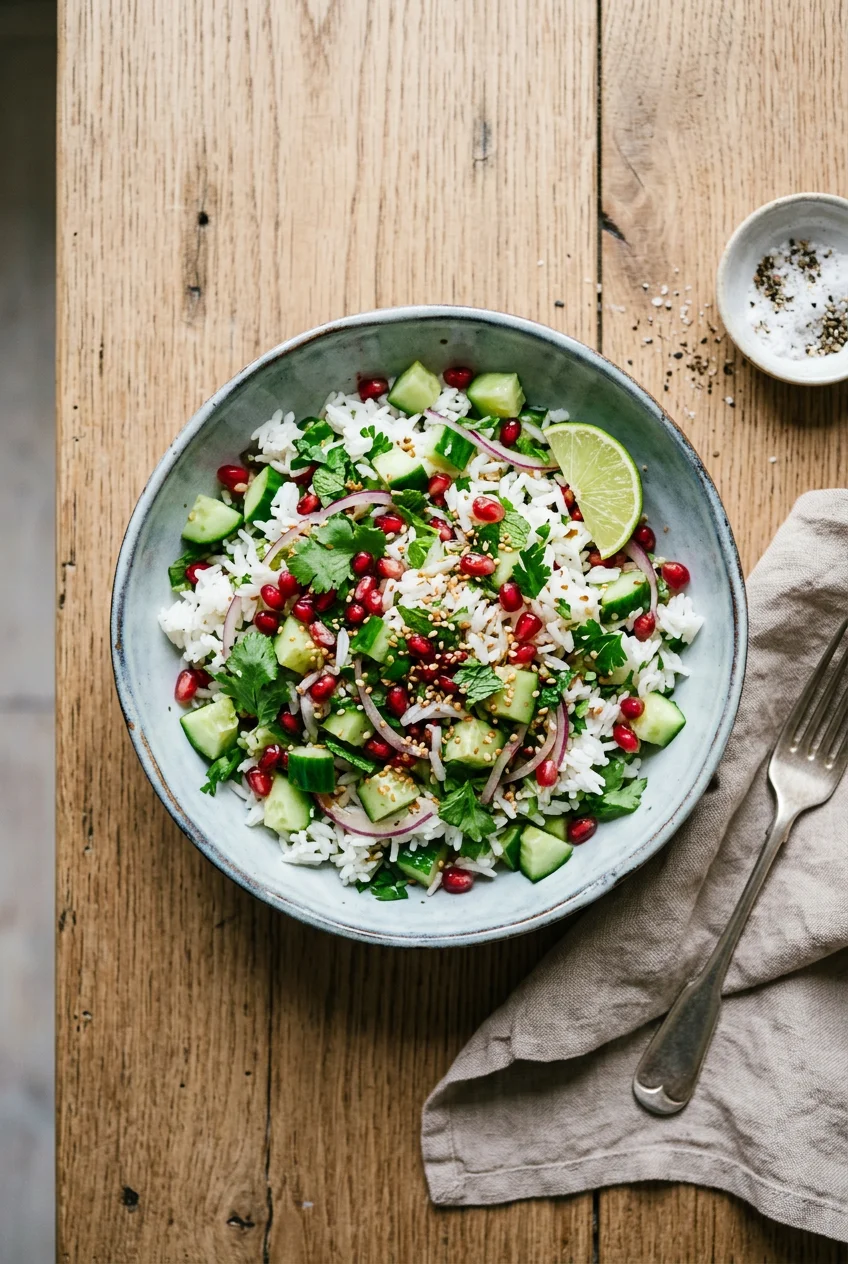
Large, chunky vegetables ruin the eating experience. If you have to open your mouth wide for a massive wedge of cucumber, the ratio is off. The goal is to get a little bit of rice, a piece of vegetable, and a herb leaf in every bite. You do this by finely dicing everything. I aim for pieces no larger than a black bean. I incorporate about 1/2 cup each of red bell peppers, English cucumber, and halved cherry tomatoes. There is a specific prep rule here: you must drain watery vegetables before they hit the bowl. I made a batch last summer with fresh garden tomatoes and cucumbers. I just chopped them and tossed them in. By the next morning, the vegetables released a half cup of water, diluting my dressing and turning the rice into soup. Now, I dice the cucumbers and tomatoes, place them in a mesh strainer, toss them with a half teaspoon of kosher salt, and let them sit for twenty minutes. The salt draws out the liquid. You discard that water, and your salad stays crisp for days. It takes extra planning, but the firm texture is worth it. You might also like: 8 Healthy Snacks On The Go Worth Trying
6. Craft a Bright Homemade Vinaigrette

Store-bought dressings are generally terrible for grain salads. They rely on thickeners like xanthan gum and cheap soybean oils that congeal when cold. Even better brands like Primal Kitchen are tricky. Their Greek dressing is fine, but at $7.99 a bottle, it’s an unnecessary expense when you can make a cleaner version in two minutes. The formula for a proper rice salad vinaigrette needs a sharp acid to cut through the starch. In a small jar, whisk together 3 tablespoons of extra virgin olive oil, 2 tablespoons of fresh lemon juice, 1 teaspoon of Dijon mustard, and 1/2 teaspoon each of dried oregano and cumin. The Dijon acts as an emulsifier. Without it, the oil and lemon will separate in the fridge, leaving your rice coated in raw oil. I shake the jar until the liquid looks creamy and opaque. You can adjust the acid depending on your vegetables, but this ratio prevents the salad from tasting flat. Pour this over the rice while the grains are at room temperature, never ice cold. Warm grains absorb the acid much faster.

Ultimate Air Fryer Perfection: 185 Remarkable Recipes That
A dependable everyday pick — Ultimate Air Fryer Perfection: 185 Remarkable Recipes That Make the Mo. Not flashy, just solid.
7. Don’t Skimp on Fresh Herbs

Dried herbs belong in the vinaigrette, but fresh herbs belong in the salad. A common mistake is treating fresh parsley or cilantro as a minor garnish. In my kitchen, herbs are a primary salad green. They provide a peppery contrast to the heavy grains. I stir in a full 1/4 cup of finely chopped fresh parsley, cilantro, or mint just before portioning the salad. You have to be careful where you buy your herbs. I bought cilantro at Kroger last month that looked fine under the store misters but turned into black slime in my drawer two days later. Inspect the stems before buying. They should be firm and pale green, not mushy. Wash the herbs and dry them completely in a salad spinner. If you chop wet herbs, they bruise and oxidize, turning your beautiful green additions into bitter specks. I use a sharp chef’s knife and slice through the leaves once. Rocking the knife repeatedly crushes the cellular structure and leaves all the flavorful oils on your cutting board instead of in your food. Clean cuts preserve the flavor.
8. The Nutritional Yeast Umami Boost

Grain salads often lack the deep, savory umami you get from roasted meats or aged cheeses. If you’re keeping the meal dairy-free, it can taste one-dimensional, just acid and starch. I fix this by adding fortified nutritional yeast. I use Bragg Nutritional Yeast. A 4.5 oz shaker is $6.49 at Trader Joe’s. It looks like yellow fish food, but it provides a nutty, cheesy flavor that changes the profile of the dish. I sprinkle 1 to 2 tablespoons directly over the salad before tossing it with the dressing. The flakes dissolve, thickening the vinaigrette slightly and coating the rice. Beyond the flavor, it packs a nutritional punch. Two tablespoons offer 5 grams of complete protein and over 300 percent of your daily value for Vitamin B12. I didn’t get the appeal of nutritional yeast for a long time. I tried eating it raw on popcorn once, inhaled a flake, and coughed for ten minutes. The trick is letting it hydrate in the dressing. It gives the cold rice a rich, savory depth that makes you actually want to eat your prepped lunch on a Thursday. No exaggeration.
9. Introduce a Serious Crunch Factor

Texture fatigue is a real problem with meal prep. When every bite has the same soft consistency, your brain gets bored before your stomach gets full. You need a loud crunch to break up the monotony. I fold in 1/4 cup of toasted nuts or seeds. Pine nuts are the traditional choice for Mediterranean profiles. They are undeniably expensive. A one-pound bag at Costco will run you between $30 and $40. If you buy them, you must toast them carefully. I ruined a $10 handful of pine nuts last Thanksgiving by walking away for thirty seconds. They went from pale yellow to charcoal black instantly. Toast them in a dry skillet over medium-low heat, shaking the pan constantly until they smell fragrant. If pine nuts aren’t in the budget, sliced almonds or raw pumpkin seeds work perfectly. The key is to keep the nuts out of the salad until the morning you eat it. If you mix toasted almonds into the wet rice on Sunday, they will be soft and rubbery by Monday afternoon. Keep a small jar of toasted seeds on your counter and sprinkle them on top right before you leave.

Gordon Ramsay’s Healthy
A dependable everyday pick — Gordon Ramsay’s Healthy. Not flashy, just solid.
10. The Trending Crispy Rice Method

If you’re tired of standard boiled grains, there’s a trending prep method for 2026 that totally alters the texture. Instead of just cooling the rice, you fry it. You need day-old, refrigerated rice for this to work. Freshly cooked rice has too much surface moisture and will just steam, turning into a sticky mess. I take my cold, al dente brown rice and press it into a hot skillet with 1/4 cup of neutral, high-heat oil. I prefer Chosen Foods Avocado Oil. A 16.9 oz bottle is $12.99 at Walmart. Press the rice down firmly with a spatula and leave it alone for five to seven minutes over medium-high heat. Don’t stir it. You want the bottom layer to turn golden and crunchy. Once it forms a crust, break it into chunks and fold those clusters into your fresh vegetables and dressing. The contrast between the cold, juicy tomatoes and the hard, crunchy rice is incredible. It takes ten extra minutes, but it makes a basic prep taste like a restaurant-quality dish. Honestly, this changed how I view leftovers.
11. Master the Advance Prep Storage

How you store your salad determines whether you’ll actually eat it or throw it away on Friday. Plastic containers retain smells. If you store vinaigrette-soaked salad in a cheap plastic tub, that plastic will smell like garlic and cumin for the next decade. I strictly use glass containers with locking lids. A 3-cup rectangular Pyrex set costs about $19.99 at Walmart. The glass doesn’t stain, doesn’t warp in the dishwasher, and keeps food colder. When prepping for the week, I divide the cooled rice and drained vegetables into the glass containers. I don’t add the dressing. I keep the vinaigrette in a separate small jar. The acid in the lemon juice will slowly break down the cellular walls of the cucumbers and peppers if they sit in it for four days. Each morning, I pour one-fifth of the dressing over my portion, shake the container, and top it with my seeds. This modular storage method guarantees the Monday portion and Friday portion taste exactly the same. You’re putting in the effort to cook clean food. Don’t ruin it with lazy storage habits.
Prepping grains doesn’t have to result in a sad desk lunch. Once you master the al dente cook and the baking sheet cooling trick, you’ll have total control over your meals. I highly recommend starting with the Lundberg brown rice and a simple lemon vinaigrette. You’ll quickly see why skipping the store-bought versions is worth the minor prep work. If you found these technical breakdowns helpful, pin this article to your meal prep board for Sunday. Let me know in the comments if you try the crispy rice method.
Frequently Asked Questions
Why is my rice salad mushy?
Mushy rice salads happen when you overcook the grains or trap steam by storing hot rice in a sealed container. Cook the rice al dente, drain it early, and spread it flat on a baking sheet to cool rapidly.
How long do rice salad recipes last in the fridge?
When stored properly in airtight glass containers, a dressed rice salad will last 3 to 4 days. If you keep the vinaigrette and wet vegetables separate until serving, the base ingredients can last up to 5 days.
Can I use white rice for meal prep salads?
White rice lacks the structural integrity of whole grains and tends to break down and clump when soaked in dressing. It’s better to use firm grains like brown rice, wild rice, or black rice for advance prep.
Do I need to rinse canned beans before adding them to a rice salad?
Yes, always rinse canned beans or chickpeas thoroughly. The starchy liquid from the can will make your salad dressing cloudy and can introduce a metallic, processed flavor to your fresh ingredients.
